
The owners most likely to sell haven't listed anything
The off-market listings module cross-references county assessor, recorder, and tax collector records — plus Secretary of State LLC filings and permit history — against zoning capacity and site-suitability criteria, then returns one ranked list with the public-record evidence attached to every signal. Found a strong one? Send it straight into an EZFeasi feasibility study.
Motivated sellers don't advertise
And suitable sites don't sort themselves. Finding both at once — an owner who's actually ready to sell, on a site that pencils for affordable multifamily — usually means a predevelopment team pulling records parcel by parcel, county by county, by hand. That doesn't scale, and the strongest leads are easy to miss.
- Tax delinquency, ownership tenure, and mortgage records live in separate county systems that don't cross-reference each other.
- Tracing an LLC owner back to a person means working through Secretary of State filings one registered agent at a time.
- A parcel can be a strong motivated-seller lead and still be the wrong site.
- By the time a promising parcel gets flagged by hand, it's often already under contract with someone else.
What gets checked
Every parcel is scored on two independent signal groups, each with the record attached.
Motivated-seller signals
Delinquent Property Tax
Owners behind on property tax are more likely to consider an offer.
Long Hold, Low Basis
Long ownership tenure at a low tax basis often means room to sell profitably.
Absentee LLC Ownership
Out-of-state or absentee LLC owners are often disengaged from day-to-day management.
Mortgage Maturity Risk
An approaching balloon payment or loan maturity can push an owner toward a sale.
No Recent Permit Activity
A lack of recent permits can signal a stalled or deprioritized property.
Never Professionally Listed
Parcels that have never hit the open market carry no competing-buyer pressure.
Site-suitability signals
AB 2011 Max Density Tier
Qualifies for AB 2011's highest density and height tier, based on the parcel's transit access.
CDLAC Location Benefit
Clears the distance-band test behind CDLAC's Location Benefit tiebreaker.
Fire Hazard Severity Zone
Flags a CAL FIRE-designated fire hazard zone, which triggers added wildland-urban-interface construction requirements and can restrict some funding sources.
Grocery Access
Within CTCAC's site-amenity proximity threshold of a full-scale grocery store.
High-Quality Transit Area
Falls within a California High-Quality Transit Area — relevant to CEQA streamlining, Density Bonus law, and AB 2011.
Library Proximity
Within CTCAC's site-amenity proximity threshold of a public library.
Medical Facility Proximity
Within CTCAC's site-amenity proximity threshold of a federally-qualified health center.
Opportunity Area
Located in a CTCAC/HCD Highest or High Resource opportunity area.
Parcel Size
Above the ~0.5-acre practical minimum for viable multifamily site assembly.
Park Access
Within CTCAC's site-amenity proximity threshold of a public park or protected-land holding.
Pharmacy Proximity
Within CTCAC's site-amenity proximity threshold of a pharmacy.
QCT/DDA Basis Boost
Sits in a HUD Qualified Census Tract or Difficult Development Area, boosting eligible basis to 130%.
Rural (CTCAC)
Meets CTCAC's "Rural" definition under a USDA, non-metro-county, or small-city test.
School Proximity
Within CTCAC's site-amenity proximity threshold of a public school.
Transit Proximity
Within a half-mile of a transit stop with 15-minute or better weekday headway.
Zoning Headroom
Zoned for multifamily use, with the current improvement below the zoned unit count.
How it works
Choose a county
Start from the counties your pipeline covers.
Pull the public-record layers
Assessor, recorder, tax collector, permit index, Secretary of State filings, and public listing status for every parcel in scope.
Trace ownership to a person
Where title sits with an LLC, follow the registered agent and Statement of Information filings to the managing member on record.
Score motivated-seller signals
Tax delinquency, low-basis ownership, absentee LLC ownership, mortgage maturity risk, stalled permits, and listing history, with the record attached to every hit.
Screen for site suitability
16 signals in all — zoning/density headroom, transit and AB 2011 tiers, CTCAC/CDLAC resource-area and site-amenity distances (grocery, school, library, medical, park, pharmacy), parcel size, QCT/DDA basis boost, fire hazard exposure, and rural status — so a lead isn't just a motivated owner, it's a site you could actually build on.
Return a ranked list with sources attached
Send a strong one straight into a new EZFeasi feasibility study.
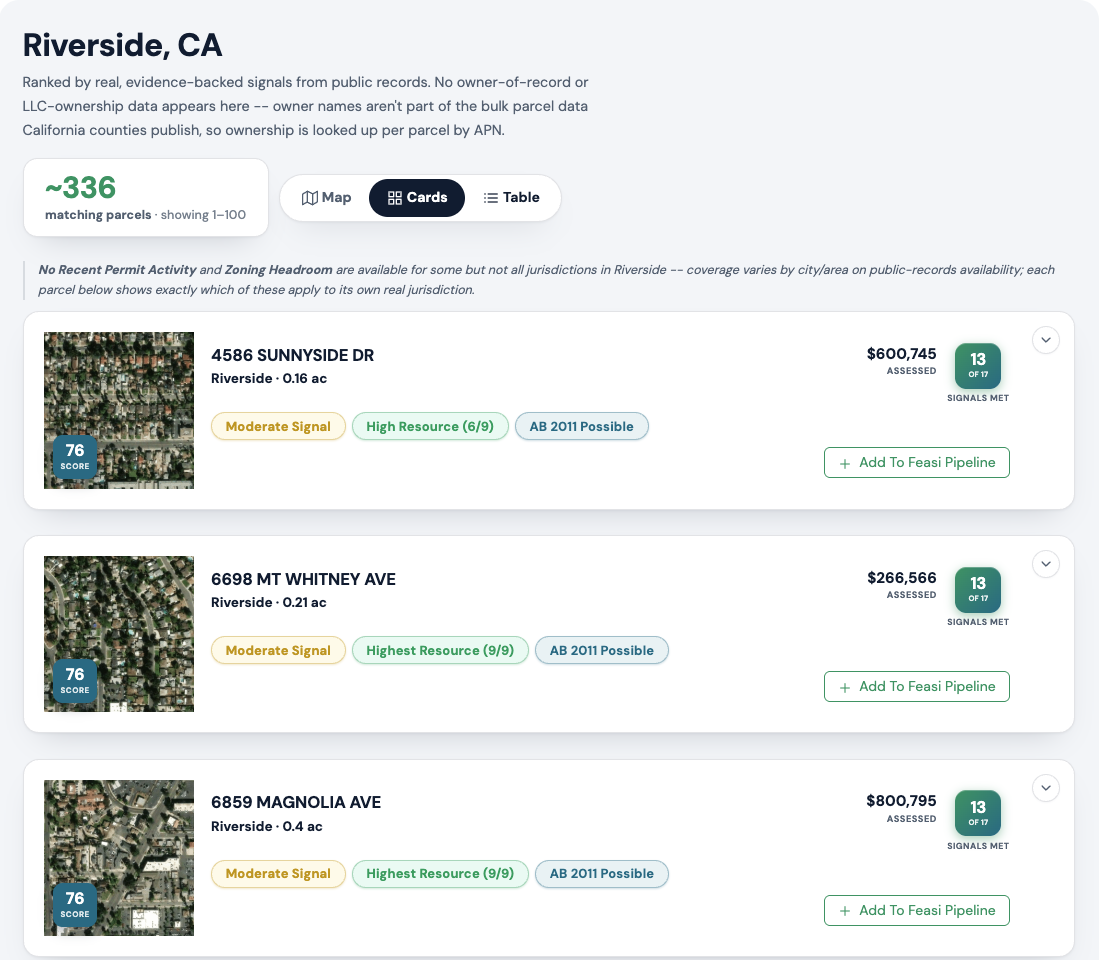
PARCEL SEARCH ENGINE
Find the opportunity.
See the signals.
Bring public-record site signals into focus. Review a parcel’s location, resource indicators, and assessed value before deciding what deserves a closer look.
Keep the parcel image, address, and screening signals together.
Review the evidence, then add the parcel to your feasibility pipeline.
Live product example from Riverside County. Parcel search currently covers Riverside and San Diego Counties, California.
Explore parcels beyond traditional listings.
Check which public-record signals apply to the site.
Bring promising parcels into your project workflow.