




Skip to content

Blog

The Average Income Test: LIHTC's Third Minimum Set-Aside, Explained

The Average Income Test: LIHTC's Third Minimum Set-Aside, Explained

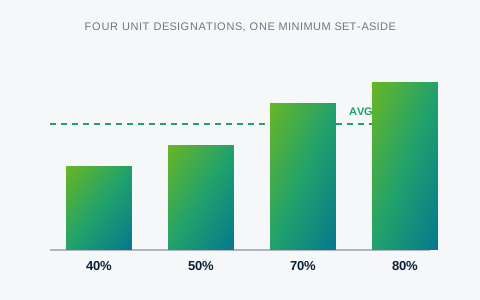
IRC Section 42(g)(1)(C) added a third minimum set-aside option to LIHTC in 2018 -- one that lets a project mix units from 20% up to 80% of AMI as long as the average lands at 60% or below. Here's how the designations work, and how a 2022 Treasury rule closed the compliance trap that made early adopters nervous.

Read Article
Private Activity Bonds and the 4% Credit: How Volume Cap Actually Works

Private Activity Bonds and the 4% Credit: How Volume Cap Actually Works

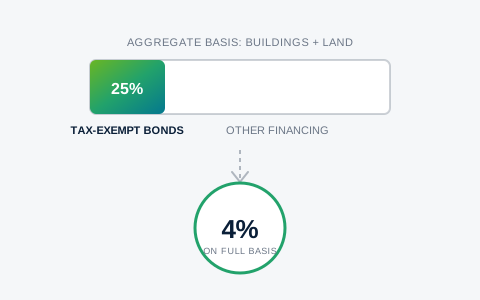
The 4% credit isn't awarded in a competitive round at all -- it's triggered automatically once a project clears a tax-exempt bond financing test. Here's how private activity bond volume cap actually works, and why a 2025 statutory change to that test just freed up a meaningful share of it.

Read Article
HOME Funds and LIHTC: How the Two Programs Actually Layer Together

HOME Funds and LIHTC: How the Two Programs Actually Layer Together

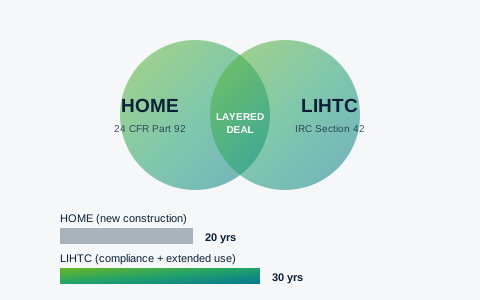
HOME is the most common federal subsidy paired with the Housing Credit, but it runs its own affordability clock, its own rent limits, and its own review process -- all separate from LIHTC's. Here's how the two programs actually fit together under 24 CFR Part 92.

Read Article
Year 15, the Qualified Contract, and the Right of First Refusal: How a LIHTC Deal's Exit Actually Works

Year 15, the Qualified Contract, and the Right of First Refusal: How a LIHTC Deal's Exit Actually Works

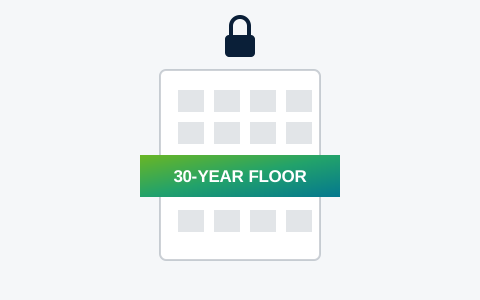
LIHTC's '15-year compliance period' is not when a deal's affordability restrictions actually end -- that's a common misreading. Here's how the real 30-year extended use period works, the narrow escape hatch Congress built into it, and the separate nonprofit right of first refusal that ended up decided in federal court.

Read Article
What Actually Goes Into a Competitive LIHTC Application

What Actually Goes Into a Competitive LIHTC Application

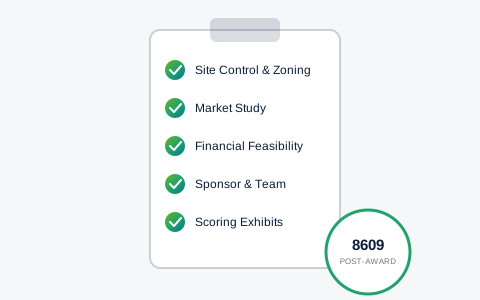
A competitive 9% LIHTC application is a lot more than a scoring narrative. Here's the real document package underneath it -- threshold evidence, the market study Section 42(m) requires, financial documentation, sponsor evidence, and what an allocating agency does with the file after the award.

Read Article
LIHTC Feasibility Checklist: What to Verify Before You Commit to a Site

LIHTC Feasibility Checklist: What to Verify Before You Commit to a Site

Use this LIHTC feasibility checklist to organize site risks, rent assumptions, costs, financing, and the next decision before committing to a parcel.

Read Article
LIHTC DSCR and Debt Sizing: A Worked Example

LIHTC DSCR and Debt Sizing: A Worked Example

See how NOI, DSCR, interest rate, and amortization affect permanent debt capacity in a LIHTC model, with a worked example and sensitivity table.

Read Article
How to Evaluate LIHTC Feasibility Software Using One Real Deal

How to Evaluate LIHTC Feasibility Software Using One Real Deal

Use a real deal and seven practical tests to evaluate LIHTC feasibility software, from source citations and scenario changes to exports and review.

Read Article
The 2026 LIHTC Funding Gap: A Bigger Ceiling, the Same Math Problem

The 2026 LIHTC Funding Gap: A Bigger Ceiling, the Same Math Problem

OBBBA permanently raised the 2026 9% credit ceiling 12%, to a per-capita multiplier of $3.416. California's competitive round still turned away nearly three of every five applicants. Here's why a bigger ceiling didn't shrink the gap, and what actually closes it on a specific deal.

Read Article
Why a Spreadsheet Per Deal Slows Down Your Whole Pipeline

Why a Spreadsheet Per Deal Slows Down Your Whole Pipeline

California's near-construction affordable housing pipeline sat at 461 developments and a $2.3 billion funding gap as of March 2026 — real evidence of how many candidate deals compete for the same scarce dollars, and why comparing them requires one underwriting standard instead of a different spreadsheet for each.

Read Article
How to Read a State QAP Competitive Scoring Rubric Before You Apply

How to Read a State QAP Competitive Scoring Rubric Before You Apply

Every LIHTC QAP runs on the same three-part structure -- threshold requirements, competitive point categories, and tie-breakers -- but IRC Section 42(m)(1)(C) leaves the weighting entirely to each state, which is exactly why the same parcel can score well in one and poorly in the next.

Read Article
The QCT/DDA Refresh: Why HUD Redraws the Basis-Boost Map Every Year

The QCT/DDA Refresh: Why HUD Redraws the Basis-Boost Map Every Year

HUD rebuilds the QCT and DDA lists from scratch every year, nationwide — the 2026 designations dropped to 14,496 qualified census tracts and 2,902 Difficult Development Areas, down from 15,727 and 2,958 the year before, without a single boundary changing shape.

Read Article
A Field Guide to the 16 Site-Suitability Signals Parcel Search Screens For

A Field Guide to the 16 Site-Suitability Signals Parcel Search Screens For

Parcel Search scores every candidate parcel against 16 real site-suitability signals spanning four different questions — what you're allowed to build, what the site is worth in a competitive round, what's actually walkable, and whether the parcel itself can support a project. Here's the full roster, grouped the way an underwriter actually reads it.

Read Article
How CTCAC Site Amenities Scoring Actually Works

How CTCAC Site Amenities Scoring Actually Works

A section-by-section breakdown of CTCAC's Site Amenities scoring under 4 CCR Section 10325(c)(4)(A) — the distance thresholds, the fine print that trips up applications, and the rural exception.

Read Article
QCT vs. DDA: How HUD's Basis Boost Designations Affect Your Deal

QCT vs. DDA: How HUD's Basis Boost Designations Affect Your Deal

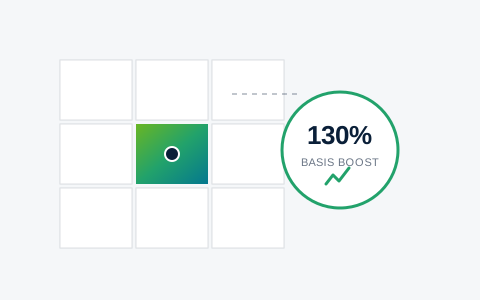
A QCT/DDA designation boosts eligible basis to 130% under IRC Section 42(d)(5)(B). Here's how the two tests actually differ, and why DDA matters more than most sites assume.

Read Article
What 'Rural' Really Means Under CTCAC (It's Not What You'd Guess)

What 'Rural' Really Means Under CTCAC (It's Not What You'd Guess)

CTCAC's "Rural" definition isn't about county maps. Three independent tests mean a site in a small city can qualify even inside a metro county.

Read Article
Reading the Sources & Uses Stack: A Primer for LIHTC Deals

Reading the Sources & Uses Stack: A Primer for LIHTC Deals

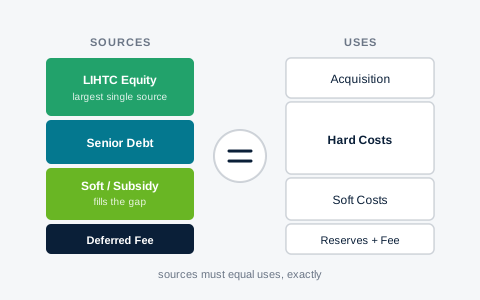
A practitioner's guide to how a LIHTC capital stack is actually built layer by layer, why it must balance exactly, and where the real underwriting time goes.

Read Article
Why the Best LIHTC Sites Never Hit the MLS

Why the Best LIHTC Sites Never Hit the MLS

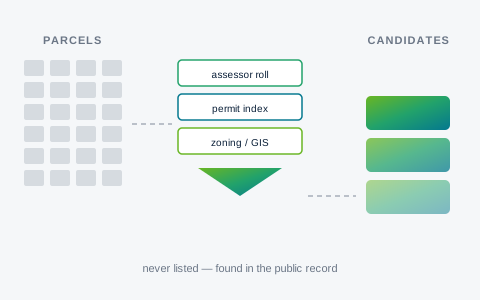
The best LIHTC parcels aren't listed because their owners aren't trying to sell. Here's how to find them in public records before anyone else calls.

Read Article
AB 2011 Explained: How California's Streamlining Law Changes the Density Math

AB 2011 Explained: How California's Streamlining Law Changes the Density Math

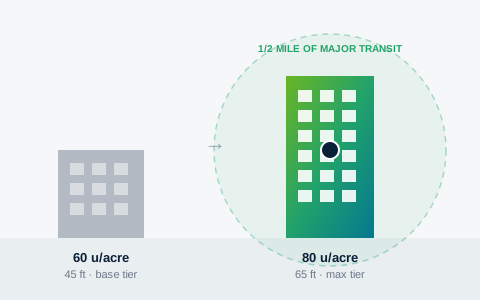
AB 2011 ties density and height directly to transit distance. Here's how the statute's tiers work, and why the transit test isn't a new map at all.

Read Article

Topics:

  • Policy (4)
  • LIHTC Financing (7)
  • LIHTC Feasibility (2)
  • Feasibility Software (1)
  • Portfolio Feasibility (1)
  • Site Sourcing (2)
  • CTCAC Scoring (2)

More Articles:

The Average Income Test: LIHTC's Third Minimum Set-Aside, Explained
  • September 29, 2026

The Average Income Test: LIHTC's Third Minimum Set-Aside, Explained

Private Activity Bonds and the 4% Credit: How Volume Cap Actually Works
  • September 29, 2026

Private Activity Bonds and the 4% Credit: How Volume Cap Actually Works

HOME Funds and LIHTC: How the Two Programs Actually Layer Together
  • September 29, 2026

HOME Funds and LIHTC: How the Two Programs Actually Layer Together

Year 15, the Qualified Contract, and the Right of First Refusal: How a LIHTC Deal's Exit Actually Works
  • September 29, 2026

Year 15, the Qualified Contract, and the Right of First Refusal: How a LIHTC Deal's Exit Actually Works