
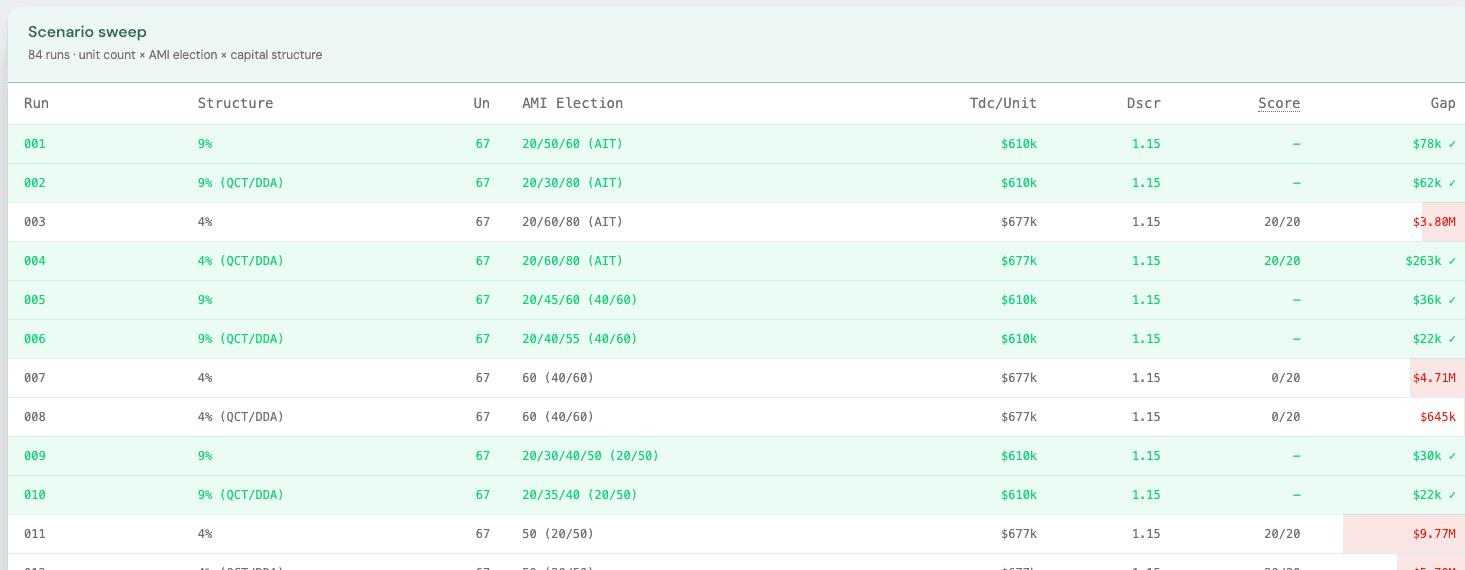



What would a better structurehave been worth?
EZOptimizer takes a filed application, runs it through the same engine as the Proforma, and looks for changes that raise cash flow without lowering the score. It shows the result for every filing, including the ones it cannot improve.
Results on 461 filed applications
California CTCAC 4% applications from the 2025 and 2026 rounds, each re-underwritten through the same engine.
Filed applications re-underwritten
Every filing in the set, whether or not the model found anything to change.
Improved without lowering a score
The other 391 are shown as filed, because the model found nothing better.
More year-1 cash flow across the 70
$44.8M over 15 years. The median improved filing gains $13,490 in year 1.
These are EZFeasi model results on public filings. They show what the structure could have carried, not what a lender, an investor or the agency would have accepted.
How to read the results
It never presents a worse deal
A change is shown only if cash flow is no lower than the filing in any year and every score is held. Across all 461 filings, none was presented below the filed figures in any year and no score went down.
Most filings were already tight
In 281 filings the rents were already at the ceiling. Where the model finds nothing to improve, it says so instead of inventing a result.
Some gains come from rents, some from debt
28 improved filings gain from rents alone. The other 42 also place a larger permanent loan, $20.6M in all, replacing $16.1M of deferred developer fee and $4.5M of soft debt.
Some of it needs a lender
The 42 that rely on a larger loan need a lender's commitment to be real. They are flagged as depending on that commitment, so a result that hangs on a lender's yes is not read as a sure thing.
Open a filing. Inspect the differences.
The Console also compares individual filed California CTCAC 4% applications with the Proforma engine, using each available full record’s unit mix, rents and loan terms.
Check one project or a cohort
Review the filed figures beside the model’s results, and inspect differences and rule checks. Missing records and assumptions are identified.
Keep the comparison honest
A credit request may reflect the deal’s need rather than the maximum its basis supports. A difference calls for review; it does not establish an error in the filing.
Explore application research →Run the same search on your own deal
The Unit Mixer sweeps unit counts, AMI elections, credit types and soft sources on your own proforma, ranks the runs by score, rent or the smallest closing surplus, and lets you protect a minimum developer fee.