


Take a deal from parcel to applicationwithout rebuilding the model
EZFeasi follows a development from the first look at a site through the filed application. The unit mix, budget, financing and scoring stay connected, so a change in one place shows up everywhere else.
What you can do in EZFeasi
LIHTC Software for Affordable Housing Developers. Pick a capability to see what it does and where it lives in the Console.
Find the site
Parcel Search scores parcels on public-record signals: ownership and tax history, transit and amenities, QCT/DDA basis boost, zoning headroom. Connect the screening evidence to your next site decision.
Start from projects like yours
The new-project starter seeds the unit mix, hard costs and impact fees from filed California 4% projects of the same kind in your county. It asks whether prevailing wage applies and holds the developer fee to its CTCAC maximum.
Check your costs against filed projects
The Hard costs comparison sets your budget against filed CTCAC 4% applications line by line: same county, same kind of project, within 30% of your unit count, same prevailing-wage election. Drop a project, add one, or bring its figures over.
Underwrite from unit mix to funding gap
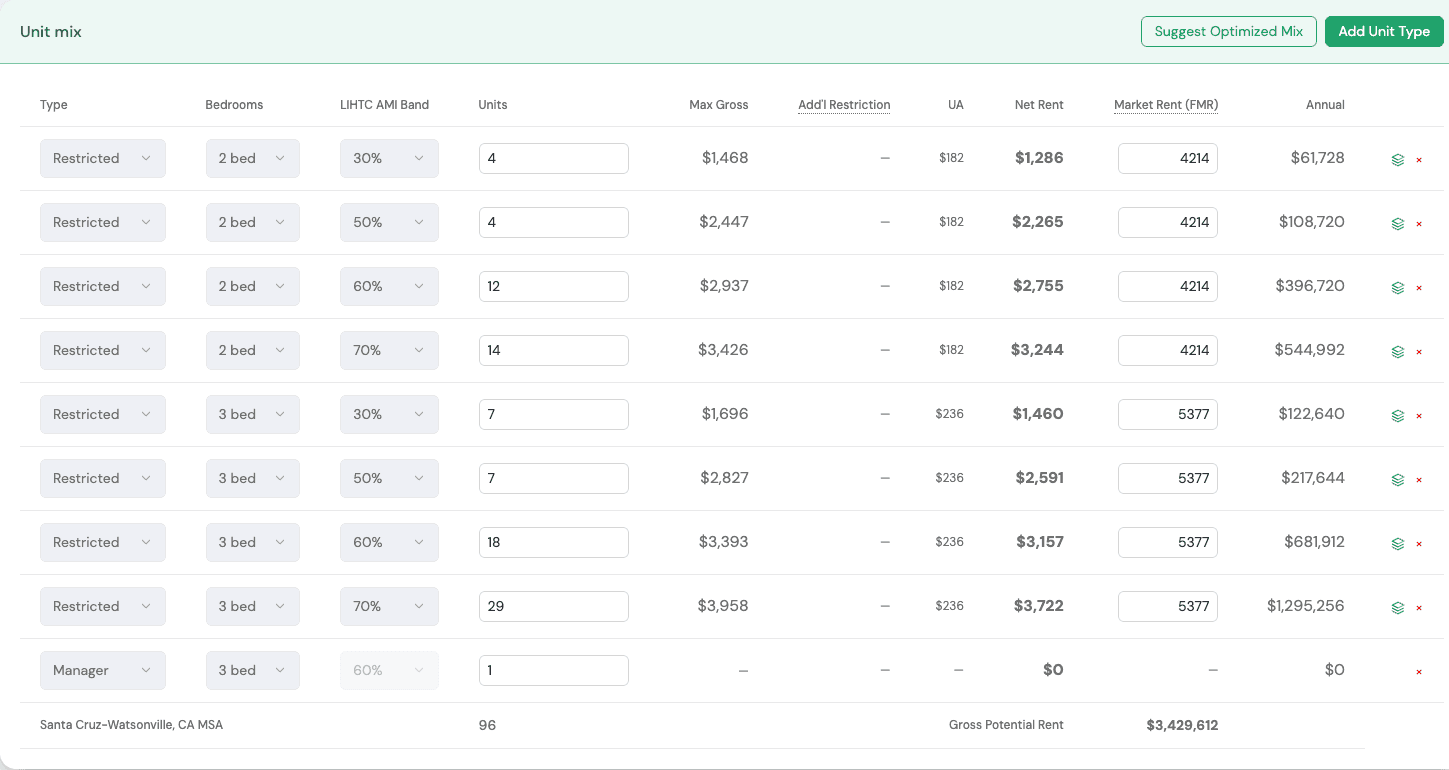
Ten workspace areas connect the project: Summary, Unit mix, Operations, Budget & basis, Financing, Equity, Investor, Cash flow, Unit Mixer and Scenarios. Investor schedules read the completed run; construction interest follows the monthly sources-and-uses draw schedule.
A developer fee built from the rule
The California fee limits are calculated, not typed: the includible maximum, the cash-eligible fee, the BIPOC joint-venture rate and the at-risk and Special Needs variants. A dropdown on the budget row shows the arithmetic behind the figure.
Find a better structure
EZOptimizer and the Unit Mixer sweep unit counts, AMI elections, credit types and soft sources through the same engine, ranked by score, rent or the smallest closing surplus. A run that cannot earn your minimum developer fee cannot win.
See where you would rank
The California scoring position card compares your project with 2026 filers and published award lists: funded counts, lowest funded points and tie-breakers by supported pool and round. Use the published outcomes to inform your competition strategy.
Carry the numbers into the application
Populate the CTCAC 2026 4% workbook from a saved run: about 215 labeled cells, with a check that your budget ties to the workbook's Sources and Uses.
Know the dates
The Deadline Calendar lists 2026 funder dates for California, Texas, Florida, New York, Ohio, North Carolina and Washington. Each deal tracks its own funder deadlines.
How a deal moves through it
- 1
Screen
Search parcels or start from a county and project type.
- 2
Seed
Start from filed projects like yours, then replace what you know.
- 3
Underwrite
Work through the tabs until the funding gap closes.
- 4
Improve
Run EZOptimizer and the Unit Mixer for a stronger structure.
- 5
Apply
Populate the application workbook and track the deadlines.
Run your next site through it
Bring a site you are evaluating and we will walk through it together.
Also for consultants, syndicators, and investors & lenders.