Previous Post
- September 29, 2026
Private Activity Bonds and the 4% Credit: How Volume Cap Actually Works
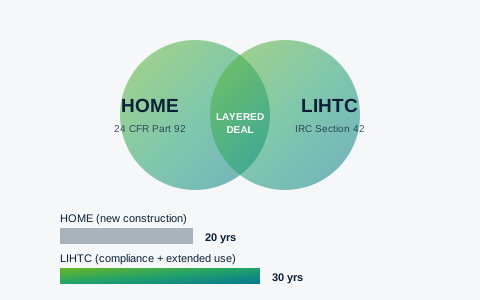
Of all the soft-money sources layered under a LIHTC deal, HOME is the one most sponsors will run into somewhere in a multi-state pipeline, since nearly every state and a large number of local governments administer their own HOME allocation. It's also a program a lot of LIHTC underwriting treats as interchangeable with any other gap-filling soft loan -- same waterfall position, same residual-receipts repayment, done. That's close enough for a sources-and-uses tab, but it skips three places where HOME actually runs on its own rules rather than LIHTC's, and where getting the interaction wrong tends to surface years into a deal's compliance period rather than at closing.
The HOME Investment Partnerships Program is a HUD formula grant, governed by regulations at 24 CFR Part 92, that allocates funds annually to states and to larger local governments and consortia that qualify as 'participating jurisdictions.' Each participating jurisdiction decides how to deploy its own HOME allocation within HUD's rules -- rental new construction and rehabilitation, homebuyer assistance, and tenant-based rental assistance are all eligible uses, and a jurisdiction's own consolidated plan determines which of those it actually prioritizes locally.
Because HOME dollars flow to a large number of separate participating jurisdictions rather than through one national office, the practical terms a sponsor encounters -- loan structure, interest rate, underwriting standards -- vary by jurisdiction even though the federal regulation underneath is the same nationwide.
This is the detail that catches sponsors off guard most often: HOME's affordability period is sized to the amount of HOME subsidy in the deal, and it runs on its own schedule under 24 CFR 92.252(e), independent of LIHTC's compliance and extended-use periods.
| HOME investment per assisted unit | Minimum affordability period |
|---|---|
| Under $25,000 | 5 years |
| $25,000 to $50,000 | 10 years |
| Over $50,000, or rehab involving refinancing | 15 years |
| New construction or acquisition of newly constructed rental housing | 20 years |
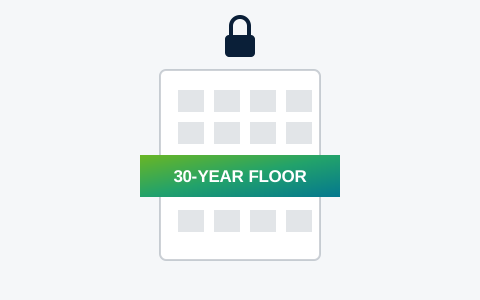
That period is measured from project completion, not from the LIHTC placed-in-service date -- the two dates are often close together, but they aren't guaranteed to be identical. LIHTC's own restrictions, meanwhile, run for a minimum of 30 years total: a 15-year compliance period under Section 42(i)(1) plus a 15-year extended use period under Section 42(h)(6)(D). On most new-construction deals, HOME's 20-year floor ends up shorter than LIHTC's 30-year floor, so the LIHTC restriction is usually what's actually controlling affordability in a deal's later years. Getting the regulatory agreement's drafting right, so the shorter HOME period doesn't create a gap or a contradiction with the LIHTC restriction still running underneath it, is exactly the kind of detail that belongs on closing counsel's checklist rather than left to boilerplate carried over from the last deal.
Layering HOME under a LIHTC deal doesn't just mean adding another source to the sources-and-uses tab. HOME regulations at 24 CFR 92.250 require the participating jurisdiction to conduct its own subsidy layering evaluation before committing funds -- confirming the combined public subsidy in the deal doesn't exceed what's actually needed for the project to be financially feasible, on top of whatever underwriting the tax credit allocating agency does independently.
That's a genuinely separate review, run by a different agency, against its own standard, on its own timeline. A sponsor that treats a HOME award as settled the moment a term sheet arrives can be surprised when the participating jurisdiction's subsidy layering review comes back later in the process and asks for adjustments to the capital stack -- a scheduling risk on top of a documentation one.
HOME-assisted units are also subject to HOME's own maximum rent limits -- published annually by HUD as 'High HOME' and 'Low HOME' rents -- which are calculated differently than LIHTC's rent-restriction formula and don't automatically match it. On a layered deal, each HOME-assisted unit has to satisfy whichever ceiling, HOME's or LIHTC's, is actually more restrictive for that unit. Modeling a layered deal against only the LIHTC rent limit, and assuming HOME rents will simply fall in line, is a common source of a rent roll that looks feasible on paper but isn't compliant on either program's own terms.
Because HOME's affordability period, subsidy layering review, and rent limits all run on separate tracks from LIHTC's own compliance mechanics, a sources-and-uses tab that treats HOME as just another soft loan misses exactly the details that surface later, during compliance monitoring or at refinancing. The sources and uses primer covers where HOME sits in the capital stack generally; for the state-specific rent and operating assumptions a layered HOME/LIHTC deal actually runs against, see the rent and operating pro forma how-to guide and select the relevant state. Book a demo to see how EZFeasi keeps a layered deal's separate rent ceilings and affordability clocks visible side by side, instead of collapsed into one number.
Use the applicable agency documents and funding-year requirements when evaluating a project.
Topic: