Previous Post
- August 18, 2026
What 'Rural' Really Means Under CTCAC (It's Not What You'd Guess)
Every LIHTC deal comes down to one spreadsheet tab: sources and uses. If you can read that tab fluently — not just what's on it, but why each line sits where it does — you can read the whole deal in about five minutes.
This is a primer on how that stack gets built, in what order, and why the ordering matters almost as much as the numbers themselves. It's written for someone newer to LIHTC deal structuring, not for someone who's closed forty of these.
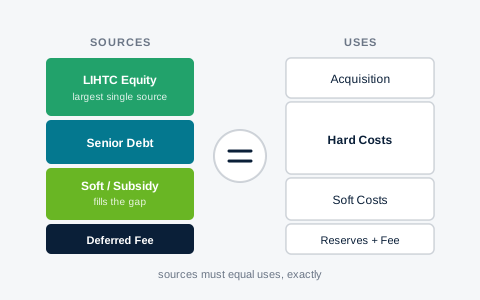
The sources side of a LIHTC deal is layered, and the layers tend to show up in roughly the same order on almost every deal you'll see.
LIHTC equity comes first and is usually the single largest source. It's raised by syndicating the tax credits to investors, who buy into the deal in exchange for the credit stream (and, on 9% deals, it can cover well over half the total development cost).
Senior permanent debt comes next — a conventional or agency/FHA-insured loan sized to what the property can actually support in stabilized cash flow. On a deeply income-restricted deal, that number is often modest, because the loan is underwritten against restricted rents, not market rents.
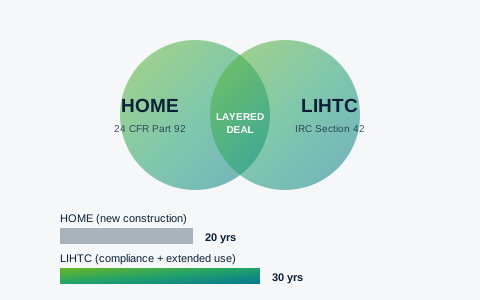
Soft or subordinate debt fills the next layer: state or local gap financing such as HOME funds, California's AHSC or MHP programs, or a local housing trust fund. These loans are typically low- or no-interest with residual-receipts repayment, meaning they get paid back from leftover cash flow after operating expenses and senior debt service, if there's any left at all.
Deferred developer fee sits at the bottom. It's exactly what it sounds like: the developer effectively lends part of their own fee back into the deal to close whatever gap remains after everything else is stacked. It's the last lever pulled, not the first.
The uses side is just the development budget, but it's worth reading closely because it tells you where the sources are actually going. The major categories are acquisition, hard construction costs, soft costs (architecture, engineering, permits, financing costs), a construction and rent-up reserve, and the developer fee itself.
None of this is exotic — it's the same budget structure you'd see on a market-rate deal. What's different is how tightly the uses side gets scrutinized against restricted-rent feasibility, and how much of the soft-cost line gets driven by the number of funding sources layered into the deal rather than by the physical scope of work.
Sources must equal uses, dollar for dollar. That's not a rounding exercise — it's the definition of a closeable deal. If uses exceed sources, something has to give: more equity, more soft debt, more deferred fee, or a cut to the scope.
The reason this layered structure exists at all comes back to rent restriction. Because rents are capped by AMI-based formulas rather than set at market rate, the net operating income a restricted property generates is lower than a comparable market-rate project, and the senior debt that income can support is correspondingly smaller. Market debt and LIHTC equity alone almost never cover the full cost of building the thing. That gap is exactly what the soft-debt and subsidy layer exists to fill.
This is the single most useful lens for reading any sources and uses tab quickly: find the gap between what senior debt and equity cover and what the project costs, and you've found the size of the subsidy problem the deal has to solve.
Stacking multiple subsidy sources is usually the single most time-consuming part of underwriting a LIHTC deal — more than the construction budget, more than the tax credit application itself.
Each subsidy source runs on its own application cycle, has its own eligibility rules, and carries its own timing requirements for commitment and disbursement. A HOME award, an AHSC award, and a local trust fund loan rarely line up on the same calendar. If one source's commitment lands three months after the tax credit reservation deadline, or its eligibility rules conflict with another source already in the stack, the whole closing can stall — not because the deal doesn't pencil, but because the pieces don't arrive in the right order.
This is why experienced sponsors start subsidy layering early and treat it as a scheduling problem as much as a financing problem. Knowing which soft-money programs a given site is even eligible for, before you commit real underwriting hours to a deal, is often the difference between a stack that closes on time and one that doesn't close at all.
In practice, most experienced underwriters read a sources and uses tab in the same order it gets built: check the equity assumption, check what senior debt the restricted rents actually support, size the resulting gap, and then see what soft sources are proposed to fill it. A deal where the gap looks small relative to comparable projects, or where the soft-debt layer leans on a single uncertain source, is worth a second look before you go further.
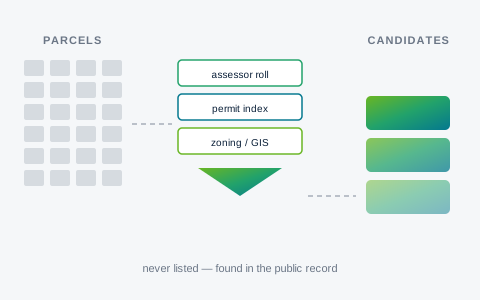
This is the same signal EZFeasi's Parcel Search is built to surface early — pulling zoning, AMI, and site-level data together so a developer can see, before committing hours to a full underwriting, roughly how large that subsidy gap is likely to be and which state and local soft-money programs a given parcel is even eligible for.
Use the applicable agency documents and funding-year requirements when evaluating a project.
Topic: