Previous Post
- September 29, 2026
HOME Funds and LIHTC: How the Two Programs Actually Layer Together

'Year 15' gets used casually in LIHTC conversation as shorthand for when a deal's affordability restrictions expire. That's not quite what the statute says, and the gap between the shorthand and the actual mechanics matters most to exactly the people who rely on it least often: sponsors and investors approaching a deal's first realistic exit point, sometimes fifteen years after they last had reason to reread the documents that govern it.
The compliance period, defined at Section 42(i)(1), is 15 taxable years beginning with the year a building is placed in service. It's the period during which the credit itself is subject to recapture risk if the project falls out of compliance.
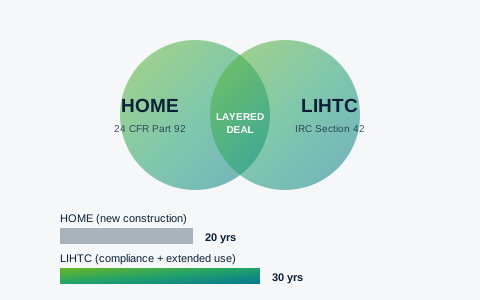
The extended use period is a separate, additional restriction, defined at Section 42(h)(6)(D): it runs from the first day of the compliance period through the later of a date the state housing credit agency specifies, or 15 years after the compliance period ends. In practice, every LIHTC project carries a 30-year floor on its affordability restrictions -- the 15-year compliance period plus a minimum 15-year extended use period after it -- and many state QAPs require longer than the federal 30-year floor as a scoring preference or outright requirement.
'Year 15,' in other words, is the end of the compliance period, not the end of the extended use restrictions. The restrictions that actually govern who can live in the units and at what rent keep running for another 15 years, or longer depending on the state, after that.
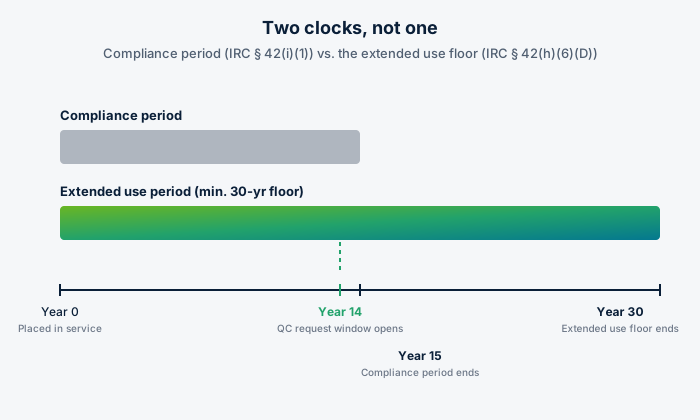
Congress did build one federal exit ramp into the extended use period, and it's narrower than it's often described. Under Section 42(h)(6)(E), once the compliance period reaches its 14th year, an owner can submit a written request asking the state housing credit agency to find a buyer for the property under a 'qualified contract.' The agency then has one year from that request to present a bona fide contract to purchase the low-income portion of the project.
The purchase price isn't a market appraisal. Section 42(h)(6)(F) sets a statutory formula: the qualifying price is based on outstanding debt, the owner's original equity investment, and other specified basis items, reduced by cash distributions -- built to return the owner's original investment plus an inflation adjustment, not current fair market value. If the agency can't present a qualified contract within that one-year window, the extended use restrictions terminate.
Termination isn't immediate for tenants already living there. Section 42(h)(6)(E)(ii) imposes a 3-year tenant protection period after termination: for three years, an owner can't evict an existing low-income tenant except for good cause, or raise gross rent beyond what Section 42 would otherwise have allowed.
The qualified contract process reads, on its face, like a guaranteed exit at year 14. In practice it almost never functions that way anymore, because most state housing credit agencies have used their own authority to shut it down as a live option. According to the National Council of State Housing Agencies, 33 states either require applicants to waive their right to request a qualified contract as a condition of receiving credits, or use QAP scoring incentives that make waiving that right the practically inevitable choice for a competitive applicant.
The result is that for a large majority of deals allocated in recent years, the qualified contract process described above is a federal statutory right the project waived at application, not a live exit option available at year 14. Whether a specific deal actually retains the right depends entirely on that state's QAP language and the specific waiver, if any, the original application agreed to -- which makes it a document to go find, not an assumption to carry forward from a different deal in a different state.
Separately from the qualified contract, Section 42(i)(7) authorizes a right of first refusal, held by a qualified nonprofit organization, a tenant organization, a resident management corporation, or a government agency, to purchase the project once the compliance period ends. The purchase price under this provision is lower still than the qualified contract formula: outstanding debt on the property plus the seller's exit taxes, full stop. It's designed as a preservation tool, letting a mission-driven nonprofit general partner, or an affiliated nonprofit, take the project into permanent ownership at a price that doesn't require paying investors a market-rate return for giving up the asset.
Because that price sits so far below what an investor limited partner might otherwise realize on an open-market sale, ROFR provisions have been a recurring source of dispute between nonprofit general partners and their investor limited partners at exactly the moment a deal approaches its exit.
The clearest example is SunAmerica Housing Fund v. Pathway of Pontiac, decided by the Sixth Circuit Court of Appeals on May 10, 2022. The investor limited partner argued the nonprofit's right of first refusal was never properly triggered, because the 'offers' the general partner solicited to set a purchase price weren't genuine, arm's-length offers under ordinary real estate common law -- they were letters of intent the general partner itself had solicited, with no real intent to sell to anyone but its own nonprofit affiliate. A federal district court agreed and ruled for the investor.
The Sixth Circuit reversed. Its holding was that a Section 42(i)(7) right of first refusal has to be interpreted inside the statute's own purpose -- facilitating nonprofit acquisition after the compliance period -- rather than measured against ordinary common-law expectations for a real estate right of first refusal, which would make the statutory right effectively unusable. The court sent the case back for trial rather than resolving every factual question itself, but the legal standard it set has since become a reference point other courts and practitioners use when a ROFR dispute turns on what counts as a legitimate trigger.
The practical lesson isn't the specific outcome -- it's that a ROFR clause drafted without the statute's actual purpose in mind is exactly the kind of provision that ends up litigated a decade or more after signing, long after the people who negotiated it have moved on from the deal.
None of this changes anything about a deal at closing -- it changes everything about how the deal reads fifteen, twenty, or thirty years later, which is exactly why it's worth getting into the file correctly the first time rather than reconstructing it from memory near year 14. Knowing which set-aside, extended-use term, and qualified-contract waiver a specific deal actually carries is a documentation question as much as a modeling one. Book a demo to see how EZFeasi keeps a project's compliance-period and extended-use terms attached to the deal record itself, not buried in a closing binder nobody has opened since.
Use the applicable agency documents and funding-year requirements when evaluating a project.
Topic: