Previous Post
- September 29, 2026
Year 15, the Qualified Contract, and the Right of First Refusal: How a LIHTC Deal's Exit Actually Works
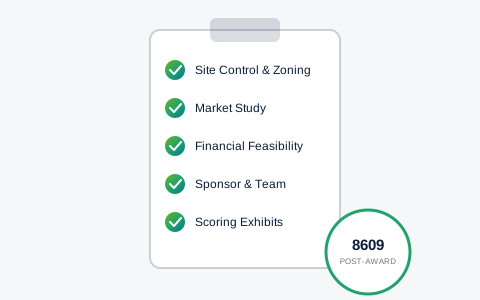
Reading a QAP's scoring rubric tells you how an application gets ranked. It doesn't tell you what actually has to be in the file -- or the upload portal, in most states now -- before an application is even eligible to be ranked. We've covered how to read a state's scoring rubric separately; this is the companion piece, walking through the real document package a competitive application requires. State specifics vary, but the categories below show up in some form in essentially every state's process.
Every QAP requires a baseline of threshold documentation before an application is even eligible to be scored: evidence of site control (a deed, purchase agreement, or long-term option), zoning consistent with the proposed use or a credible entitlement path, evidence of utility availability, and confirmation the site doesn't carry a disqualifying environmental or floodplain condition. None of this is scored on a point scale -- it's pass or fail, and a threshold failure typically ends the application regardless of how strong its scoring narrative is.
Financial feasibility documentation sits in this same threshold category in most states: a sources-and-uses budget, a multi-year operating pro forma, and evidence that proposed financing sources are more than aspirational -- typically a letter of interest at minimum, and often a firmer commitment for the largest sources.
One threshold document is a federal requirement, not a state invention. Internal Revenue Code Section 42(m)(1)(A)(iii) requires every state's qualified allocation plan process to include a comprehensive market study of the housing needs of low-income individuals in the project's area, prepared before the credit allocation is made by a party independent of the project's own development team.
States implement this requirement with their own specifics -- who qualifies as an 'authorized' or independent market analyst, what the study has to cover (typically a defined primary market area, a capture-rate and absorption analysis, and comparable rent evidence), and how current the study has to be relative to the application deadline. The underlying requirement traces back to the same federal statute in every state, which is worth knowing if a market study prepared for one state's application gets reused or adapted for a different state's filing -- the independence and content requirements aren't automatically identical.
Beyond the sources-and-uses tab, a competitive file typically includes an appraisal, a construction cost estimate or general contractor bid detailed enough to support the hard-cost line, and firm term sheets or commitment letters for the largest proposed funding sources -- the same distinction between committed and aspirational financing that matters in any feasibility review, documented formally here rather than modeled internally.
Sponsor and development team documentation rounds out the package: prior project experience and a track record of completed, stabilized LIHTC properties; evidence of the sponsor's financial capacity to carry the deal through construction; and, depending on the state, architect and general contractor qualifications submitted as part of the same file rather than left to a later design-review stage.
Only after the threshold package is assembled does the scoring narrative -- the exhibits and write-ups addressing each of a QAP's point categories -- actually matter, because a scoring narrative attached to a threshold-deficient application doesn't get read as a competitive entry at all. That's the reverse of how a lot of predevelopment time actually gets spent: it's easy to over-invest in polishing a scoring narrative for site amenities or income targeting while an underlying threshold item -- site control language, a market study's independence requirement, a financing commitment that's still just a term sheet -- sits unresolved.
The application package doesn't stop mattering once an award is announced. Once a project is placed in service, the allocating agency issues IRS Form 8609 for each building in the project, certifying the credit allocation the owner then claims annually over a 10-year credit period. And for the life of the extended use period, the same agency is required under Section 42(m)(1)(B)(iii) to monitor the project for compliance and report any noncompliance it finds to the IRS on Form 8823 -- the same file built during the application process is often the first reference point when a compliance question comes up years later.
That's the practical argument for treating the application package as a real record, not a one-time submission exercise: the site control documentation, the market study, and the financing commitments filed at application are frequently the first documents pulled when a compliance monitor, an investor, or a lender needs to confirm something about the deal a decade into its extended use period.
A useful predevelopment discussion treats the application package as a checklist to close out, not a narrative to write at the end. The LIHTC feasibility checklist covers the decision discipline; this piece is the document inventory underneath it. Book an EZFeasi demo to walk through how a specific site's threshold documentation, market evidence, and financing commitments come together before a filing deadline, not after.
Use the applicable agency documents and funding-year requirements when evaluating a project.
Topic: