Previous Post
- August 26, 2026
Why a Spreadsheet Per Deal Slows Down Your Whole Pipeline

Open a state's Qualified Allocation Plan for the first time and the instinct is to jump straight to the scoring matrix -- find the point categories, tally what a site might earn, check the number against what the last funded application scored. That instinct skips most of the document, and the part it skips is usually what decides whether an application gets funded at all.
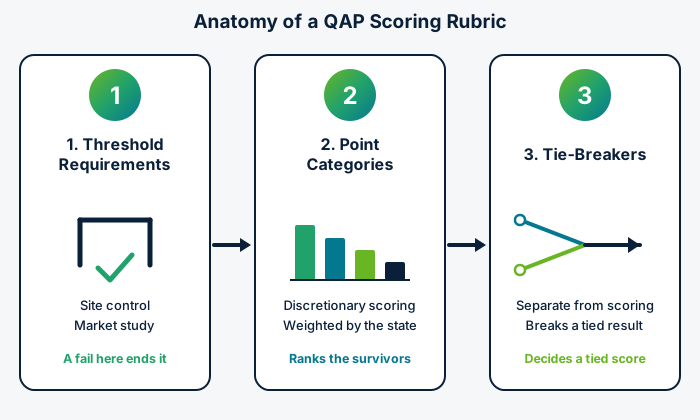
A QAP isn't a single scorecard. It's three mechanisms stacked on top of each other: threshold requirements deciding whether an application is even eligible to be scored, point categories ranking the applications that clear that bar, and tie-breaker criteria deciding the outcome when the point categories don't produce a clean winner. Congress requires this structure of every state agency -- Internal Revenue Code Section 42(m)(1)(B) mandates that credit be allocated under a QAP, and Section 42(m)(1)(C) lists roughly ten selection criteria every plan must address in some form. What the statute doesn't do is tell a state how much weight to put on any of it, and that's where the fifty-one QAPs currently in force -- one per state plus DC -- stop resembling each other.
Threshold requirements come first, and they aren't scored -- they're pass or fail. A typical threshold section requires site control, zoning consistent with the proposed use, evidence of need such as a market study, a financial feasibility showing the deal works, and often a local support letter or an extended-use commitment beyond the federal 30-year floor. An application that fails one threshold item is out before a reviewer ever looks at its site amenities, income targeting, or sponsor track record -- the single most common reason a competitive application never reaches scoring, regardless of how strong the deal looks on the merits.
Applications that clear every threshold item move into the point categories -- discretionary, competitive scoring where an agency ranks everything that made the cut against criteria it chose when writing the plan. This is what most people mean by "scoring," and it's also where states diverge most sharply, since the statute leaves the weighting entirely up to each agency.
Because point categories tend to compress into a handful of achievable totals, ties among applications happen constantly. Every QAP needs a separate mechanism to resolve them, and a tie-breaker sits entirely outside the point categories -- whatever factor the state decided should settle a draw when the scorecard alone can't.
The statute gives every state the same starting material. Section 42(m)(1)(C) requires a plan to address roughly ten factors in some form -- project location, housing need, project and sponsor characteristics, tenant populations with children or special needs, public housing waiting lists, eventual tenant ownership, energy efficiency, and a project's historic nature, among others. Section 42(m)(1)(B)(ii) layers on three mandatory preferences: projects serving the lowest-income tenants, projects committing to serve tenants the longest, and projects in a qualified census tract whose development contributes to a concerted community revitalization plan. That's the entire federal blueprint. States decide the rest -- how many points each factor carries relative to the others, whether it's even framed as its own category, and what actually satisfies it.
That last part is where two states can score the identical parcel two different ways without either one violating the statute. A review of all fifty state QAPs and DC by Freddie Mac and the National Housing Trust found that states approach "opportunity" -- access to jobs, schools, transit, low poverty -- through genuinely different frameworks. Illinois writes it explicitly: the Illinois Housing Development Authority defines opportunity areas by low poverty and strong job access and scores a project directly on whether it sits inside one. Alabama's plan doesn't use the word "opportunity" at all, and instead scores proximity to specific services -- grocery stores, hospitals, banks. A parcel in a genuinely high-opportunity tract that happens to sit a mile from the nearest grocery store scores well under Illinois's framework and could score poorly under Alabama's, not because the site changed, but because the two states are measuring different things and calling both of them "location."
A site's score, in other words, isn't a property of the site -- it's a property of the site measured against one agency's rubric, in one year. Underwriting a parcel against the wrong state's assumptions, or against a category that doesn't exist where you're actually filing, produces a scoring estimate that's confidently wrong rather than usefully wrong.
Layered on top of the point categories is a separate structural choice: set-asides. Federal law requires at least 10% of a state's annual credit ceiling to go to projects with a qualified nonprofit sponsor, under Section 42(h)(5) -- Congress bars an agency from allocating more than 90% of its credits to deals without material nonprofit participation. Most states go well beyond that floor and carve out additional pools on their own initiative: rural set-asides, permanent supportive housing, preservation of expiring affordability, tribal or veteran-serving housing, USDA Rural Development-financed deals, and others, each sized entirely at the state's discretion.
A set-aside changes who you're actually competing against. A general-pool application competes against every 9% deal filed that round; a rural set-aside application competes only against other rural-eligible applications for a much smaller slice of the ceiling. The same site, filed under two different pools, or in a state that doesn't offer the set-aside it would otherwise qualify for, faces a completely different competitive field.
Because ties are routine, tie-breaker criteria do more work in a competitive round than their placement at the back of the QAP suggests, and states pick genuinely different things to measure. New Hampshire's tie-breaker rewards the most efficient use of credit -- the lowest tax credit requested per unit. Texas added a similar tie-breaker keyed to the lowest credit request per low-income unit. South Carolina uses the lowest share of total development cost funded by the state authority, a criterion commenters in that state's own QAP process flagged as risking a "race to the bottom" on requested subsidy. Nevada folds project readiness -- whether construction can start and finish within the plan's stated timeframe -- directly into its tie-breaker. California's Tax Credit Allocation Committee uses a leveraging test, comparing the non-tax-credit financing an application brings against its overall cost.
None of those is "the" tie-breaker method -- they're five different answers to the same question, chosen independently by five agencies. What they share is that each measures something the point categories don't. A deal that scores near the top of its pool on housing need, site quality, and sponsor experience can still lose the final ranking to one that scored lower but asked for less credit per unit or could break ground sooner.
None of this is fixed once you've read it. A state's LIHTC allocation resets every year under Section 42(h)(3)(C)'s per-capita formula -- for 2026, the greater of $3.416 per resident or a $3,953,600 floor, under Revenue Procedure 2025-32 -- and that reset is largely why agencies revise their QAP on a roughly annual cycle: publish a draft, run a public comment period typically around 30 days, and adopt a revised plan before the next round opens. A few agencies have moved to two-year QAPs -- New Hampshire, Massachusetts, and Utah currently run 2025-2026 plans -- but even those get amended mid-cycle when a category proves unworkable.
The National Council of State Housing Agencies, representing the state HFAs of all fifty states, DC, and several territories, tracks this churn nationally and publishes recommended practices for how agencies administer the credit -- the closest thing to a single vantage point on QAP activity across the country, precisely because no two agencies revise on the same calendar or in the same direction. The practical consequence: a scoring rubric you modeled against a year ago may already describe a plan that no longer exists. Verifying you're underwriting against the current adopted plan isn't a formality -- it's the difference between a scoring estimate and a guess.
This is why EZFeasi's Developer Guide is built the way it is: per-state underwriting parameters and competitive scoring rubrics extracted directly from each state's actual current QAP, covering all fifty states and DC, so the categories, set-asides, and thresholds a deal gets modeled against are the ones actually in force for the round you're filing in, not a summary written when the plan last changed. Pair that against the Awards Matrix -- real awarded 9% and 4% projects pulled from each state's own published award roster, with unit count and credit amount -- and you can check a site's fit against a rubric, and against what that state's agency has actually funded recently under it, before spending the underwriting hours a mismatch would waste.
Use the applicable agency documents and funding-year requirements when evaluating a project.
Topic: