Previous Post
- August 26, 2026
The 2026 LIHTC Funding Gap: A Bigger Ceiling, the Same Math Problem
Run more than one LIHTC deal at a time and a coordination problem shows up that single-deal underwriting advice never has to deal with: every site is sitting in its own spreadsheet, built at a different moment, usually by whoever happened to be carrying that deal that month. The vacancy assumption in one file doesn't match the vacancy assumption in the next one over. The reserve sizing follows whatever standard felt right to the analyst who built it, not necessarily the standard the deal actually needs. Nobody can say with confidence why the developer fee percentage on file three is a full point higher than the one on file one.
None of that is a problem when a sponsor is carrying a single deal — an idiosyncratic spreadsheet is still a correct spreadsheet if it's the only one you're running. It becomes a real problem the moment a sponsor is carrying four or five candidates at once, because the entire point of a pipeline is comparison: deciding which site clears feasibility, which one gets the next round of predevelopment spend, which one gets walked away from. A comparison built across five different sets of underwriting assumptions isn't actually a comparison. It's five separate opinions that happen to be sitting in the same folder.
The inconsistency isn't usually the result of anyone doing sloppy work. Most bespoke deal files start as a copy of whatever template the sponsor used last time, then get modified one judgment call at a time: a debt coverage ratio nudged because a lender mentioned a number on a call, a vacancy factor tightened because a comp felt optimistic, a soft-cost contingency padded because the analyst building the file had a bad feeling about the site's environmental history. Every individual change is defensible. Stack five files full of independently defensible changes next to each other and they stop being comparable, even though nothing in any single one of them is actually wrong.
The file itself compounds the problem. Every analyst structures a spreadsheet differently — tab order, named ranges, where the AMI mix sits relative to the debt sizing. When a deal changes hands, which happens constantly as it moves through a pipeline, the next person inheriting the file usually can't tell at a glance whether last quarter's numbers reflect the current underwriting standard for that county or a figure someone typed in eight months ago and never revisited. The safer move, and the one most people actually make, is to not trust the inherited file and build a new one instead.
That decision to rebuild rather than trust an inherited file happens at almost every stage transition a deal goes through — sourcing to screening, screening to full feasibility, feasibility to structuring the subsidy stack. Each transition asks a genuinely different question of the site (is this worth a closer look, does this actually pencil, what combination of soft funds closes the remaining gap), which gives everyone a ready justification for starting over rather than editing what's already there. The cost isn't just the rebuild itself. It's the analyst hours that rebuild consumes — hours that aren't going toward screening the next candidate site sitting in the queue behind it.
That cost lands inside a predevelopment window that's already tight on its own terms. Commentary on this year's ROAD Act legislation has pegged the typical stretch between site control and permit at twelve to eighteen months industry-wide, with land carrying cost, interest-rate exposure, and construction-cost escalation compounding for every month a site sits in that window. A week lost re-underwriting a deal that's already been screened once is a week added to a window that's already the primary cost driver on the deal, not a neutral administrative delay.
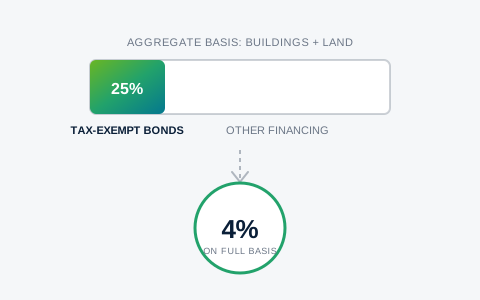
Layered on top of the file-rebuilding problem is a second one: the regulatory and financing environment a deal is underwritten against keeps moving, sometimes within the same year. The One Big Beautiful Bill Act, the federal reconciliation law that took effect last year, permanently raised the annual 9% credit allocation authority by 12% starting in 2026 and lowered the tax-exempt bond financing test for 4% deals from 50% down to 25% — both of which change what a given deal's credit basis and bond sizing should look like, depending on when a file was last touched.
Bank capacity to buy LIHTC equity moved even faster this year. Regional banks spent early 2026 running up against the 15% statutory cap on public welfare investment as a share of regulatory capital, a constraint tight enough that trade press was reporting stalled LIHTC deal flow by April. Congress raised that cap to 20% under the 21st Century ROAD to Housing Act, a change law firms were still writing client alerts about in July. A deal sourced in February and still sitting untouched in a spreadsheet by August is being evaluated against equity-market assumptions that were already out of date twice over in between.
When every deal lives in its own file, propagating a change like that means opening every open file individually and hoping none get missed. There's no way to confirm you actually caught all of them, because there's no single place the assumption lives — it lives once per spreadsheet, repeated as many times as there are deals in motion.
This is where inconsistent underwriting stops being a filing problem and starts costing real money, because predevelopment capital is scarce and it has to be allocated across candidates before anyone knows for certain which one will close. An Enterprise Community Partners analysis released in March 2026 found 461 affordable developments sitting in California's near-construction pipeline as of the end of 2025 — 39,880 homes that have already cleared local land-use approvals and design, and still need an estimated $2.3 billion in additional state subsidy to break ground. More than two-thirds of those homes, 25,802 of the 39,880, already carry a funding commitment from at least one state program; those developments are mid-stack, not at the starting line, and they're still competing for the same limited pool of remaining dollars.
That's the dynamic playing out at the scale of an entire state program. It plays out at a much smaller scale every time a sponsor with three or four candidate sites has to decide which one gets the next appraisal, the next geotechnical report, the next entitlement application fee. That decision is only as good as the comparability of what's already been modeled for each site. If Site A looks like the stronger bet only because its file used a softer vacancy assumption than Site B's, or skipped a reserve line Site B's file included, the sponsor isn't actually choosing the stronger site — they're choosing the more optimistically underwritten spreadsheet.
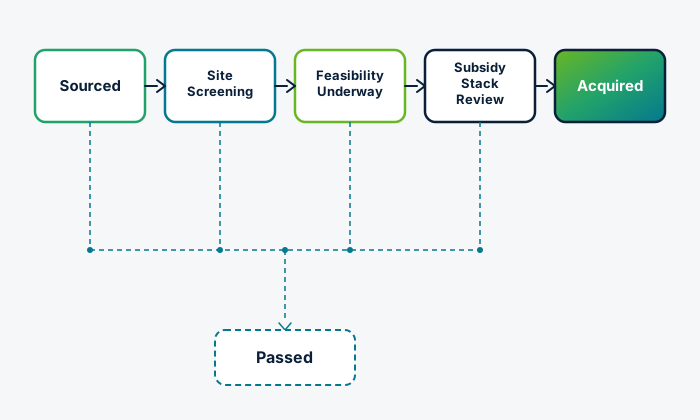
This is the exact problem EZFeasi's Feasi Pipeline is built around. It's a Kanban-style board that carries every deal a sponsor is running through six real stages: Sourced, Site Screening, Feasibility Underway, Subsidy Stack Review, Acquired, and Passed for the ones that don't clear. Because every deal lives on the same board with the same underlying data rather than in a folder of separate files, moving a site from Site Screening into Feasibility Underway doesn't mean starting a new spreadsheet — it's the same deal, carried forward, with the same assumptions attached to it that it had a stage earlier.
That's also what makes the board's headline numbers mean something. Feasi Pipeline shows active and total pipeline value across every site a sponsor is tracking at a glance — a figure that's only trustworthy if it isn't built by summing five spreadsheets that each made their own call on vacancy, reserves, and fee structure. When the deals underneath it are underwritten the same way, comparing where to spend the next predevelopment dollar stops being a matter of trusting whichever analyst built the most convincing-looking file, and starts being an actual portfolio decision.
Use the applicable agency documents and funding-year requirements when evaluating a project.
Topic: