- September 29, 2026
Private Activity Bonds and the 4% Credit: How Volume Cap Actually Works
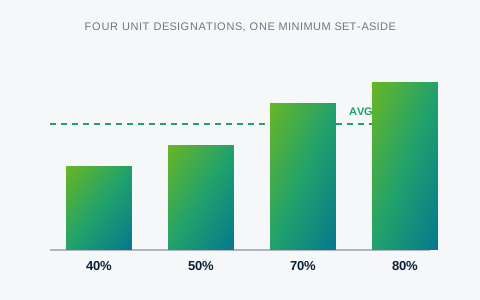
For nearly three decades, a LIHTC project had exactly two ways to satisfy its federal minimum set-aside: the 20-50 test (at least 20% of units restricted to 50% of area median income) or the 40-60 test (at least 40% of units restricted to 60% of AMI). Both are flat lines -- every qualifying unit sits at the same income ceiling. There was no way to mix a handful of deeply affordable units with a larger share of units at a higher, more financeable rent, and still count all of them toward the set-aside.
The Consolidated Appropriations Act, 2018 (Pub. L. 115-141) changed that by adding a third option to Internal Revenue Code Section 42(g)(1): the Average Income Test, at Section 42(g)(1)(C). It's the newest of the three tests, and it's also the one most developers still double-check before relying on -- partly because of how it works, and partly because of a compliance gap in the original design that Treasury didn't fully close until four years after the statute passed.
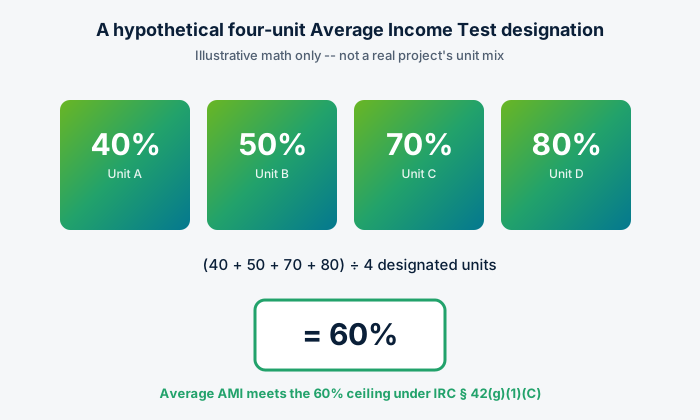
Under the Average Income Test, a project meets its minimum set-aside if 40% or more of its residential units are both rent-restricted and occupied by households at or below an income limit the owner assigns to that specific unit -- and the assigned limits, averaged across the whole qualifying group, come out to 60% of area median gross income (AMGI) or less.
The mechanism that makes this useful is unit-by-unit designation. Each qualifying unit gets assigned one of six income limits -- 20%, 30%, 40%, 50%, 60%, 70%, or 80% of AMGI -- in 10-point increments. A project can put some units at 20% or 30% AMI, serving genuinely low-income households, and offset them with units designated at 70% or 80% AMI, which support meaningfully higher rents, as long as the blended average across every designated unit doesn't exceed 60%.
That's a real change in what a developer can model. Under the 40-60 test, a unit serving a 30%-AMI household still only counts as a 60%-AMI unit for set-aside purposes -- there's no credit for going deeper. Under the Average Income Test, going deeper on some units directly buys room to go higher on others, which is the whole point of the election.
The statute created the averaging mechanism in 2018, but it left an open compliance question that made early adopters cautious: what happens if one designated unit falls out of compliance -- say, a household's income grows past its unit's assigned ceiling at recertification? Under a literal reading of the statute, a single non-compliant unit could push the group average over 60%, which would mean the entire project failed its minimum set-aside test -- not just lost credit on the one unit, but jeopardized the building's eligibility altogether. That's an outsized consequence for one household's income growth, and it made lenders and investors cautious about underwriting deals against an untested standard.
Treasury and the IRS addressed this directly. Final and temporary regulations published October 12, 2022 (T.D. 9967, 87 Fed. Reg. 61489, codified at 26 CFR 1.42-19) removed what practitioners had been calling the 'cliff effect.' The final rule applies the same 'available unit' and 'next available unit' compliance mechanics that already governed the older 20-50 and 40-60 tests, and adds specific rules for re-designating a unit's income limit when a household's circumstances change -- so a single unit drifting out of its designated band no longer threatens the whole project's set-aside, as long as the average is restored through the normal compliance mechanics rather than left to fail outright.
That four-year gap between the statute and a workable final rule is part of why some practitioners still treat the Average Income Test as the newer, less battle-tested option relative to the two tests that have been in the statute since 1986 -- even though the compliance mechanics are now settled.
The averaging election isn't only a compliance question -- it changes what a project's revenue side can look like before a single unit is built. A project that designates a meaningful share of its units at 70% or 80% AMI can support materially higher rents on those units than a flat 60%-AMI project could, while still serving a deeper-need population on units designated at 20% to 40%. Whether that trade actually improves feasibility on a specific site depends on the local rent comps at each AMI band, the QAP's own scoring treatment of income targeting (some states score a deeper average AMI favorably, independent of which federal test a project elects), and how the resulting unit mix compares against the site's supportable debt.
It's also worth being precise about scope: the Average Income Test is a federal minimum set-aside election under Section 42(g). It answers whether a project qualifies for the credit at all -- it doesn't automatically satisfy a state's own QAP scoring preferences for income targeting, which are usually a separate, additively-scored category layered on top. A project can elect the Average Income Test to hit the federal floor and still need to model a deeper average AMI to compete for a specific state's scoring points.
Modeling an Average Income Test election means testing unit-by-unit AMI designations against rent comps and against a state's own scoring rubric at the same time -- a meaningfully bigger combinatorial problem than picking a single flat AMI ceiling for the whole project. EZFeasi's Subsidy Stack Optimizer is built around exactly that kind of scenario testing, so a developer can compare a flat 60%-AMI mix against an averaged mix that goes deeper in places and higher in others, and see the effect on both revenue and QAP scoring before committing to either one. Book a demo to walk through how a specific project's unit mix compares under each minimum set-aside test.
Use the applicable agency documents and funding-year requirements when evaluating a project.
Topic: