Previous Post
- August 18, 2026
How CTCAC Site Amenities Scoring Actually Works
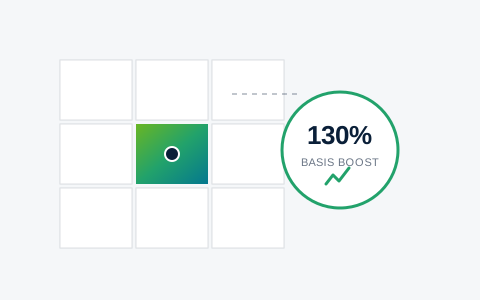
When you're penciling a deal, a Qualified Census Tract or Difficult Development Area designation can be the difference between a deal that clears its financing gap and one that doesn't. It's worth 30% more eligible basis without adding a single unit, without changing scope, without spending another dollar on construction.
And yet a lot of site selection still treats QCT/DDA status as a box checked once, early, and then forgotten. That's a mistake, and understanding why gets into how these two designations actually work — because they're not the same test, and they're not equally common.
Under Internal Revenue Code Section 42(d)(5)(B), a LIHTC project located in a QCT or a DDA gets its eligible basis increased to 130% of what it would otherwise be. If your otherwise-eligible basis is set, the boost effectively increases the credit basis you can claim, which flows through to more tax credit equity for the same building.
That's not a marginal effect. On a project where basis limits or the credit gap are already tight, the boost is often what closes the sources and uses without asking the sponsor for more deferred developer fee or a bigger soft loan.
One thing worth being precise about: the boost doesn't stack. A parcel can sit inside both a QCT and a DDA at the same time, but the eligible basis still caps at 130%, not 160%. What matters for your deal is qualifying under either designation — not both. So when you're screening sites, you're really asking a yes/no question: does this parcel hit QCT criteria, or DDA criteria, or neither.
QCT and DDA get talked about together so often that it's easy to assume they're measuring the same thing. They're not.
A QCT is an income-based designation. A census tract qualifies as a QCT if at least 50% of households have income below 60% of area median gross income, or if the tract's poverty rate is at least 25%. It's a snapshot of who already lives there.
A DDA is a cost-based designation. HUD designates an area as a DDA where land, construction, and utility costs are high relative to area median income — in other words, where it's objectively expensive to build regardless of who currently lives nearby. Metro DDAs are designated at the ZIP Code Tabulation Area (ZCTA) level; non-metro DDAs are designated by whole county. That's a meaningfully different geography than a census tract, and it means DDA boundaries don't track QCT boundaries in any predictable way.
Here's where this stops being an academic distinction. Across Riverside County's scored parcel inventory, EZFeasi found that roughly 84% of QCT/DDA-eligible parcels qualify via DDA only, about 12% qualify via QCT only, and about 5% qualify under both simultaneously.
In other words, in at least this California market, the cost-based test is doing most of the work. If a site selection process screens primarily for QCT status — because it's the more familiar term, or because someone associates the basis boost with low-income neighborhoods — it's going to miss the large majority of parcels that actually qualify. The land doesn't need to sit in a high-poverty tract to get the boost. It just needs to sit in a ZCTA (or, outside metro areas, a county) where HUD has determined construction costs run high relative to income.
This is also why a site that looks unremarkable on a poverty-rate map can still carry a basis boost, and why a site in a visibly low-income area doesn't automatically have one. The two tests answer different questions, and DDA is the more common path to yes.
Both QCT and DDA lists are republished annually by HUD (huduser.gov/portal/datasets/qct.html), driven by updated income and cost data. A parcel that qualified as a DDA two cycles ago can drop off the list, and one that didn't qualify can newly qualify, without anything about the site itself changing.
The practical implication: don't treat QCT/DDA status as something you verify once during early site selection and then carry forward as a fixed fact. Re-check status close to application time, especially if there's been any lag between site control and your CTCAC or 9% competitive round submission. A basis boost you underwrote a year ago based on a prior HUD publication cycle may not be there when you file — or, more happily, a site you passed on because it didn't qualify might now.
The takeaway isn't complicated: check both tests, not just the one that sounds more intuitive, and check them against the current HUD publication rather than an assumption carried over from an earlier round. Given that DDA alone accounted for the large majority of qualifying parcels in the Riverside County data, skipping that check specifically is the more expensive mistake.
EZFeasi's Parcel Search surfaces current QCT and DDA status directly on each scored parcel, alongside the basis boost it implies for eligible basis — so the designation shows up as part of initial site screening rather than as something confirmed later in underwriting, after a site is already under control.
Use the applicable agency documents and funding-year requirements when evaluating a project.
Topic: